
World Dracula Day
Stoker's London

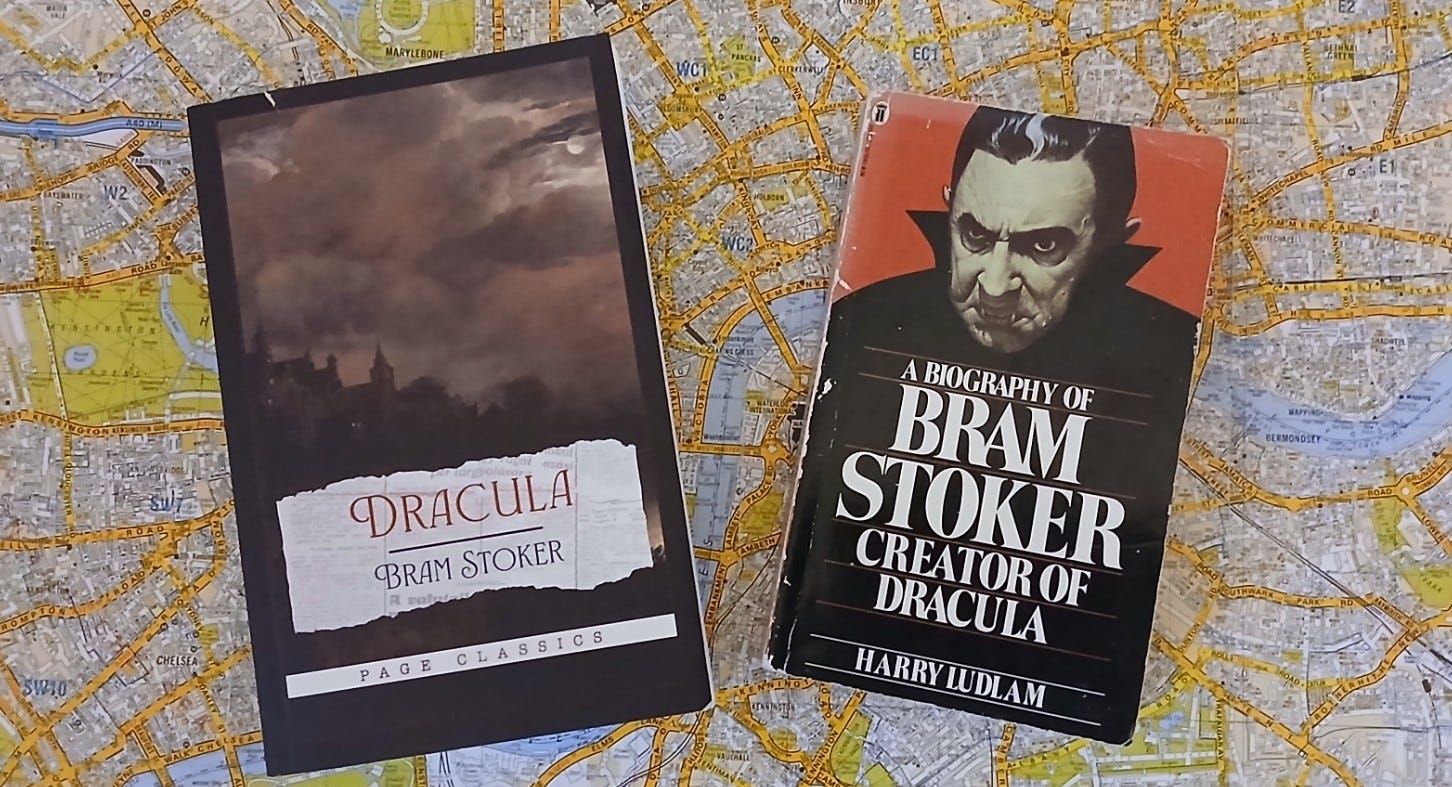
For this episode of London Fantastical I’m going to mark World Dracula Day with a tour of places in London connected to its author, Bram Stoker. World Dracula Day was officially established in 2012 by the Whitby Dracula Society, based in the Yorkshire seaside town where Dracula first arrives in England in Bram Stoker’s seminal vampire tale. The date of May 26th commemorates the anniversary of the publication date on which Dracula first hit bookshop shelves in 1897. The month of May also holds significance because the novel opens with Jonathan Harker’s journal entries in May, describing his strange journey through forests and remote villages to the ancient castle of the supernatural Transylvanian Count, high in the Carpathian Mountains.
Wellington Place
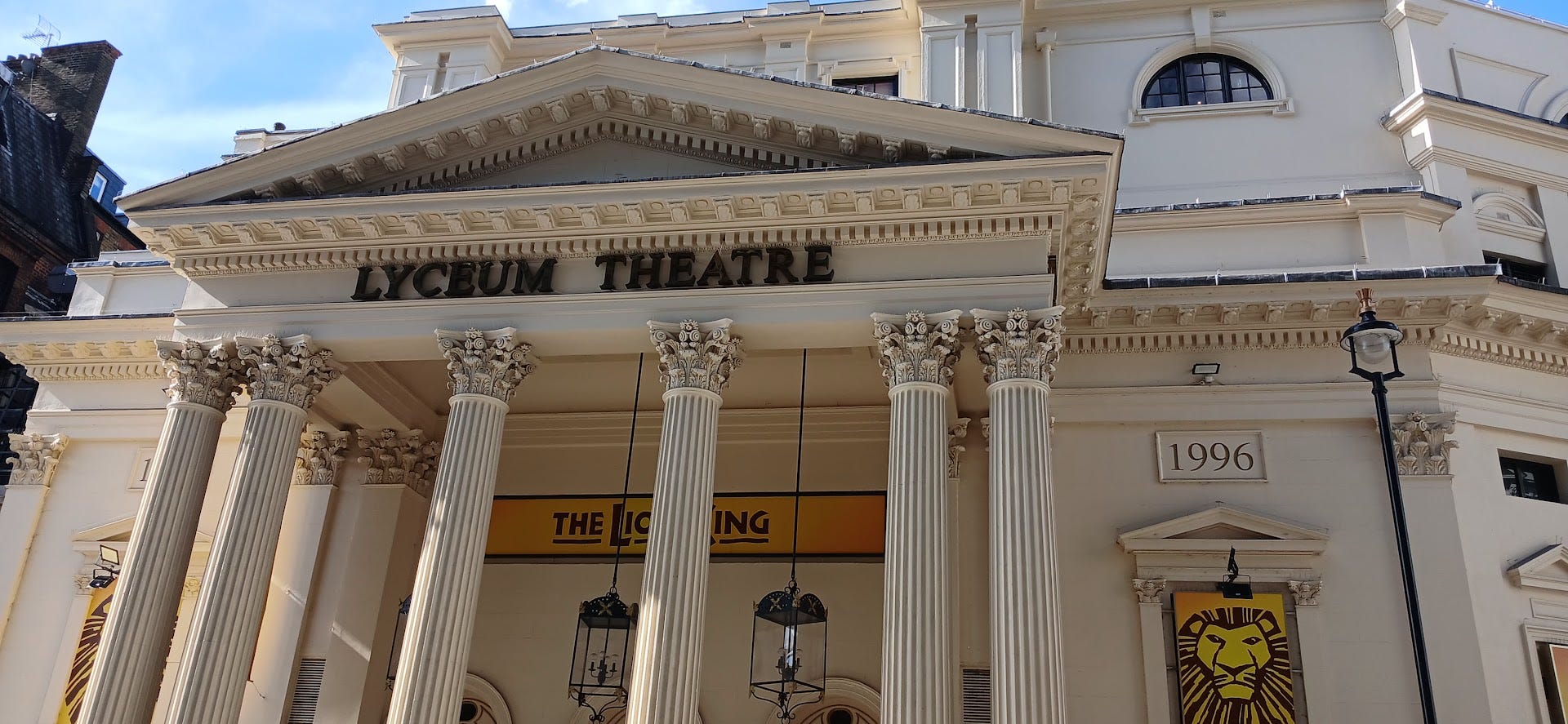
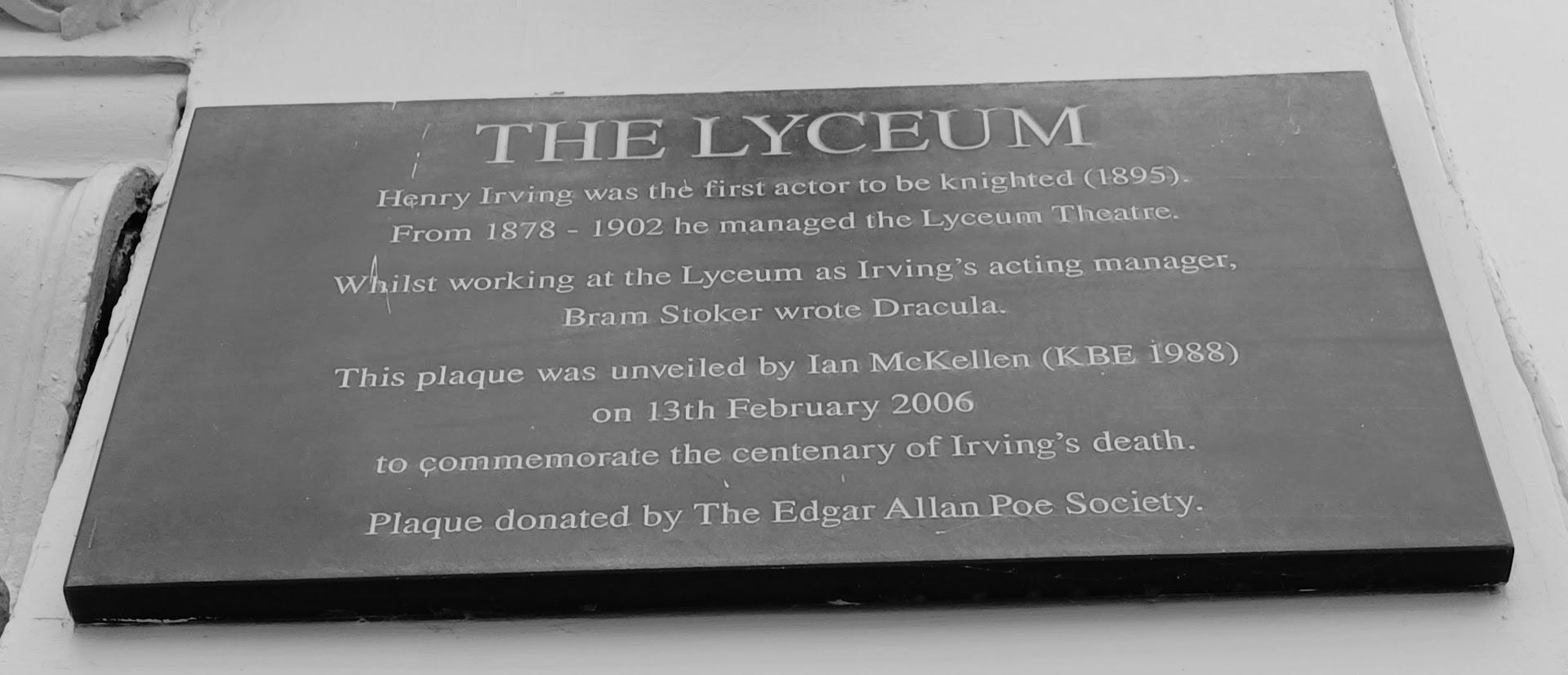
The Lyceum Theatre stands in Wellington Place, just off The Stand, near Waterloo Bridge. Bram Stoker came to London from his native Dublin in 1876 to manage the Lyceum Theatre in Wellington Place which had recently been acquired by his close friend, the actor, Henry Irving. A plaque on the front of the theatre, dedicated by the Edgar Allen Poe Society, commemorates the 27 years he spent in his position there. To the rear of the theatre Stoker’s name is carved in stone, alongside that of Irving and the Victorian actress Ellen Terry, said to be the inspiration for Mina Harker.
The Lyceum had a huge impact on Stoker’s writing ambitions, particularly the gothic melodramas staged there such as ‘The Flying Dutchman’ and the theatrical adaptation of Stevenson’s ‘Doctor Jekyll and Mister Hyde’. It’s said that Dracula’s character is partly based on Henry Irving’s own portrayal of Mestophiles in the Lyceum’s production of ‘Faust’.
Equally important were the literary dinners held in the Beefsteak Room at the back of the Lyceum. Here Stoker and Irving would host the likes of Oscar Wilde and Arthur Conan Doyle. Two of their guests during this period were to have a crucial impact on Stoker’s eventual writing of Dracula.
The first was Sir Richard Francis Burton, famed at the time for his English translations of the Kama Sutra and the Arabian Nights. He was also the author of Vikram and the Vampire, his collection of tales based on Indian folklore which features the Baital, a demonic creature inhabiting the leathery body of a huge bat, with a human face and an icy touch, which hangs from the branches of a tree in an old cemetery. Stoker was said to be fascinated by Burton’s knowledge of the undead folklore of the Asian continent. Burton’s features, described as an iron jaw and protruding teeth, which gave him a predatory look, combined with scar from a javelin wound on his cheek, are said to have also woven their way into Stoker’s depiction of Dracula.
The other guest who had a direct influence on the novel was Professor Arminius Vambrey of Budapest University who introduced Stoker to the grim history and supernatural folklore of the Carpathian Mountains, where Stoker would eventually locate Castle Dracula. Stoker corresponded with Vambrey for many years after that first meeting and it is thought the character Professor Abraham Van Helsing is based on him. In fact, Van Helsing mentions Vambrey in the novel, referring to having consulted his friend Arminius at Buda-Pesth University on the background of the mysterious Count Dracula.
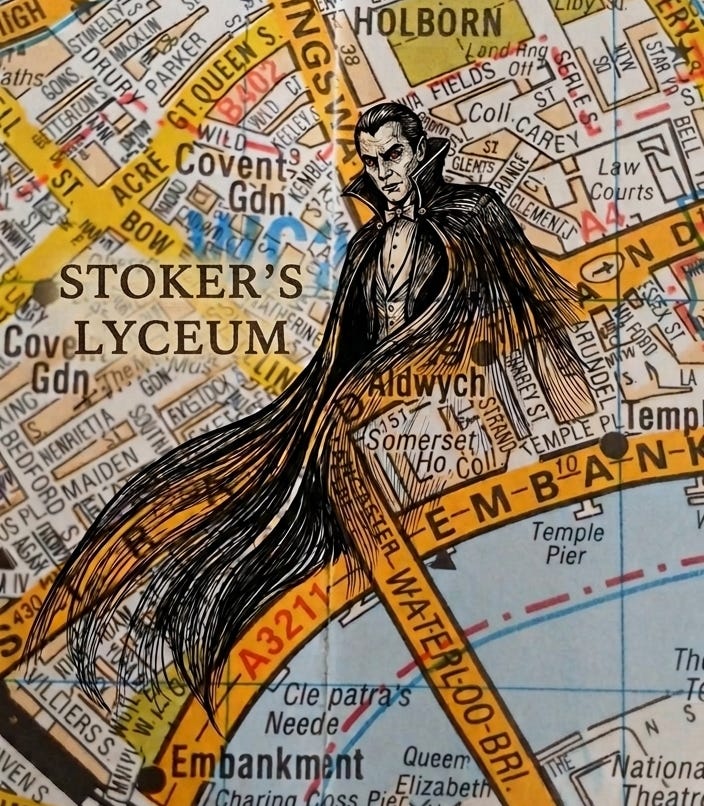
Stoker famously wrote Dracula while working at the Lyceum and the theatre itself became part of the novel’s own legend. With his experience on the management side of the theatre industry Stoker understood the importance of establishing licensing and performance rights for his upcoming novel. To do this there needed to be an actual performance. So, on May 18th, 1897, eight days before the novel was due to be published, he pulled together several members of the Lyceum troupe for a marathon live onstage reading entitled ‘Dracula; or, The Un-Dead’ which took from 10am in the morning to 3pm in the afternoon to complete. Any hopes Stoker had of a proper stage adaptation of his infant novel were dashed when Henry Irving described the gruelling five-hour experience as ‘dreadful’.
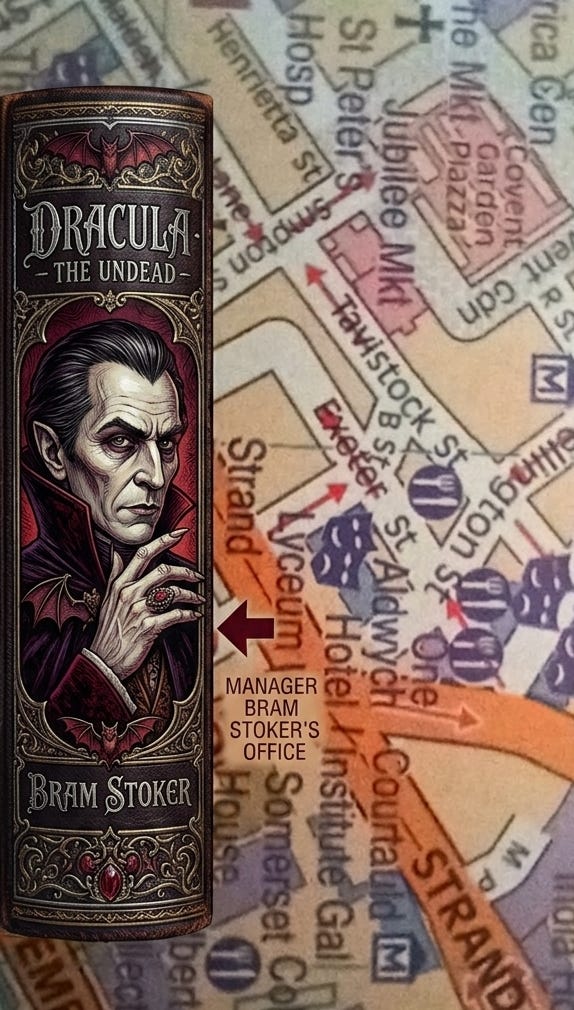
You can find my blog for London Guided Walks exploring Dracula’s Theatrical legacy here.
Stoker’s Homes
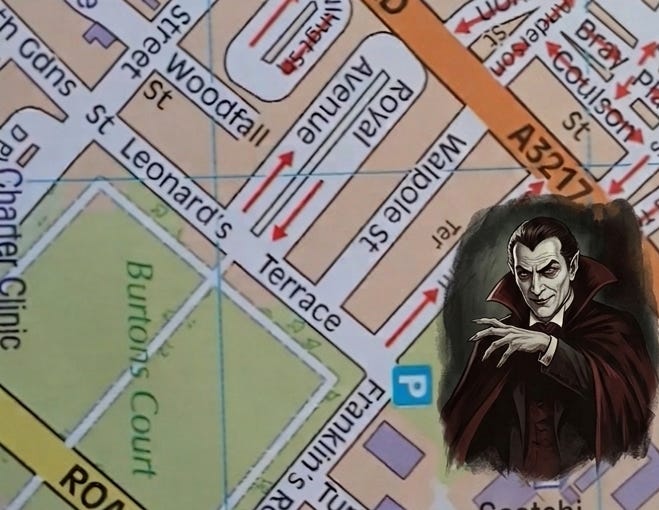
Stoker moved to London just days after marrying his wife, Florence. They initially lived in an apartment at number 7 Southampton Street in Covent Garden, a short walk from the Lyceum. They lived there for five years. Their only son, named after Henry Irving, was born there on the 30th of December 1879.
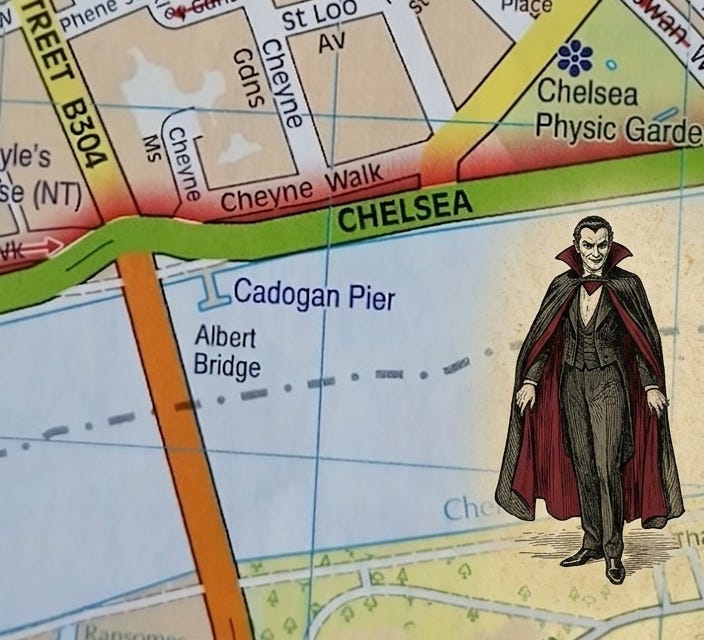
In 1881 they moved to a new home at 27 Cheyne Walk, on the banks of the Thames, near Albert Bridge, and on the opposite side of the river to Battersea Park. It was during this time that Stoker rescued a man who had attempted to commit suicide in the Thames. He was laid out on the Stoker’s kitchen table at Cheyne Walk but died before medical assistance could be summoned. The psychological impact of this event had a huge influence on Stoker’s writing of Dracula, the bulk of which was written at that address.
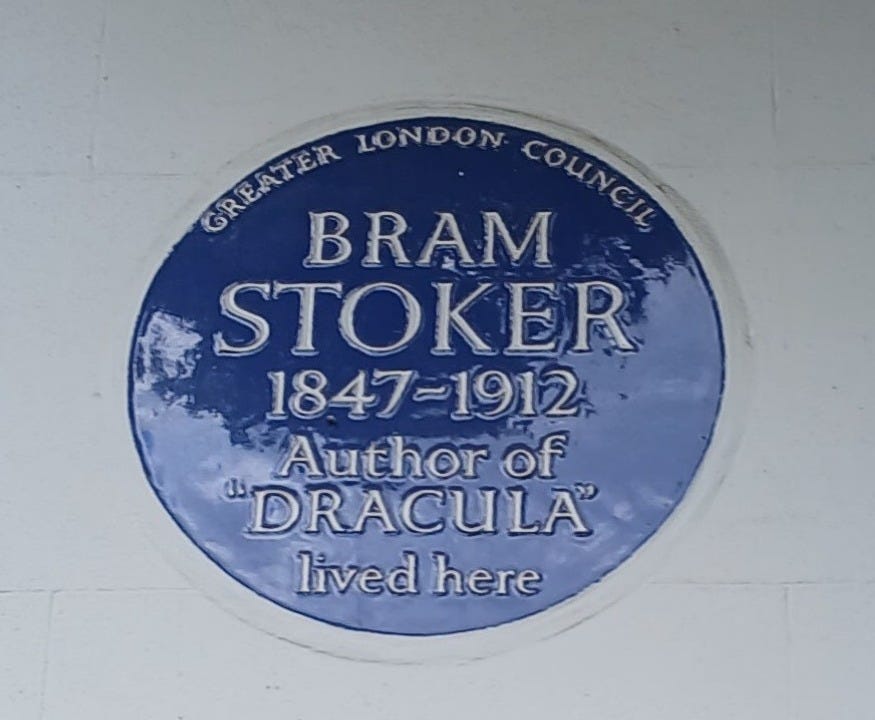
A year before the publication of the novel the family moved to 18 St Leonard’s Terrace, a four-storey house where a Blue Plaque has been installed. St Leonard’s Terrace is a short walk from Cadogan Square where Hammer’s Dracula, Christopher Lee, lived for many years, in a house where his next-door neighbour was none other that Boris Karloff. St Leonard’s Terrace is also not far from Paulton’s Square, used as the location of the home Peter Cushing’s Van Helsing in Hammer’s ‘Dracula AD 1972’.
The Stokers remained at St Leonard’s Terrace until 1906, after his tenure at the Lyceum had ended. Their new home was 26 St George’s Square in Pimlico where he wrote ‘The Lair of the White Worm’ (1911), which was made into film, directed by Ken Russell and starring Amanda Donohoe, in 1988. It was at the Pimlico home that Stoker passed away in April 2012, at the age of 64.
The London Library
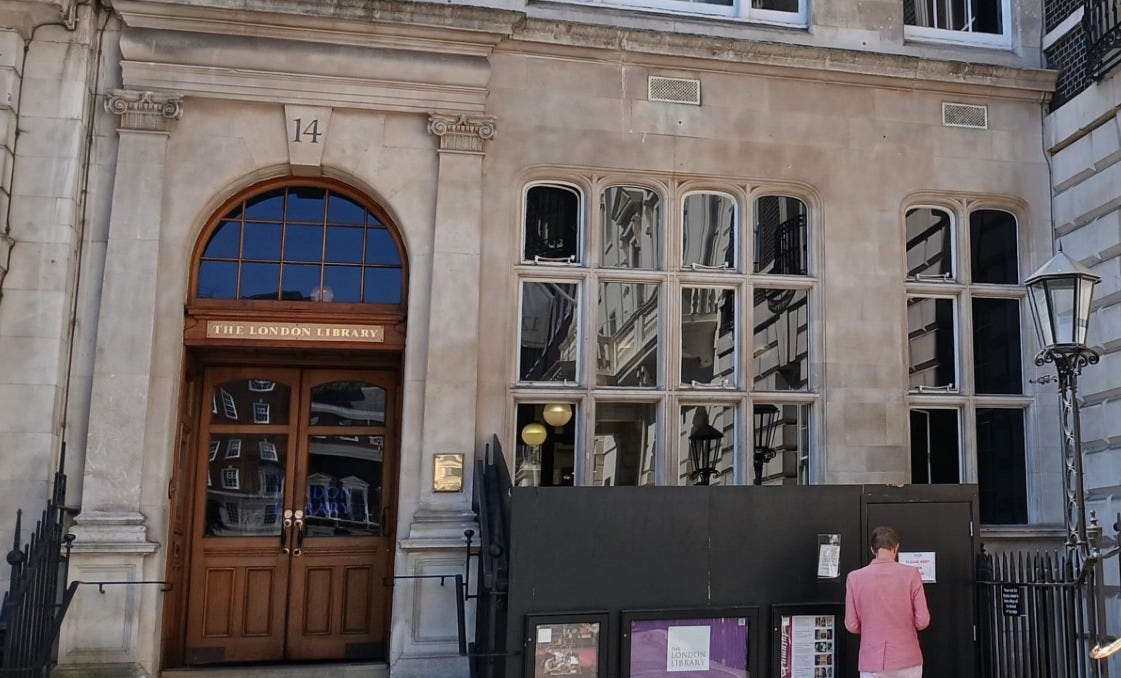
Stoker known to have made extensive use of the British Museum as part of his background investigation into the Carpathian Mountains. But the bulk of his literary research took place at The London Library in St James’s Square, located two doors away from the former home of Ida Lovelace, Lord Byron’s daughter, who was born at his Piccadilly home.
Stoker was a member of the library throughout the 1890s, the period when he was writing Dracula, and they still have in their catalogue no less that twenty-seven titles bearing pencil marks and margin notes in what has been verified as Stoker’s handwriting.
His go to work for the Eastern European folklore which underpins the Dracula legend and builds on what he gleaned from Professor Vambrey was ‘The Book of Were-Wolves’ by Sabine Baring-Gould. Baring-Gould was a clergyman by day, and the composer of the Salvation Army anthem ‘Onward Christian Soldiers’. By night he was the Victorian equivalent of today’s paranormal investigators, delving into the dark legends of shapeshifters and blood fiends. The London Library’s copy of the book is said to contain by far the most of Stoker’s notes and observations.
By contrast ‘Transylvania: It’s Products and People’ by the celebrated Victorian travel writer, Charles Boner, provided Stoker with the intimate detail he needed to depict Jonathan Harker’s strange journey through country villages and dark forests toward Dracula’s gothic mountain top castle, in the opening chapters of the novel. It was an area Stoker himself had never visited, but Boner’s descriptions of the area provided the raw material for these chapters. Stoker also used the map in Boner’s book to plot his locations, while Boner’s description of Bran Castle, which still stands today, provided the foundations for the Count’s brooding ancestral home.
Since his arrival in London Stoker had acquired a familiar knowledge of London and its suburbs. This found its way into the London locations featured in the novel.
Piccadilly
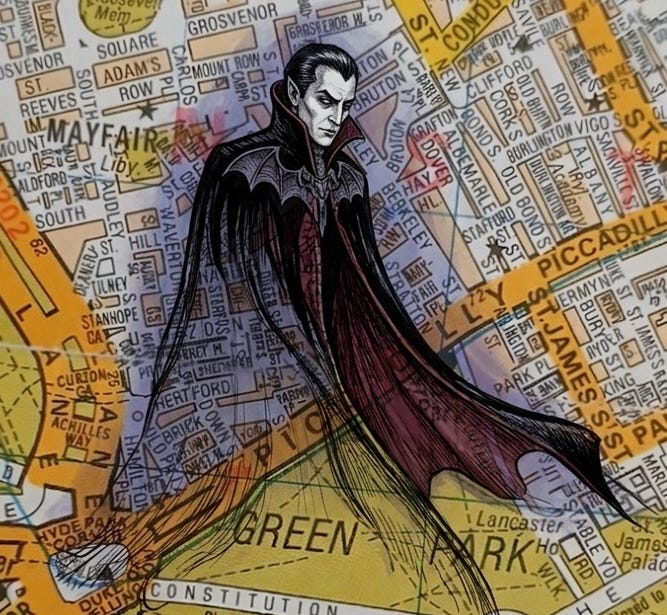
Once Dracula arrives in Britain he establishes his London home at 347 Piccadilly. In fact, the street numbers along Piccadilly don’t go that high and the Dracula Society have identified the house which stands at 138 Piccadilly as the most likely inspiration. The house next door, 137 Piccadilly, was Lord Byron’s home in the same year of his sojourn to Villa Diodati on the shores of Lake Geneva where he wrote his own vampire tale ‘Fragment of a Novel’, featuring the prototype vampire, Augustus Darvell, and where Mary Shelley wrote ‘Frankenstein’.
Dracula’s Piccadilly home is where he stores eight of the crates of the Carpathian soil which he needs to maintain his immortality. Jonathan Harker sees a rejuvenated Dracula near the house at Hyde Park Corner, which triggers traumatic memories of what he was forced to endure as a prisoner in the Count’s crumbling Carpathian Castle.
Meanwhile Van Helsing and Lord Godalming are staying at hotels at either end of Piccadilly and it is from these locations they draw up plans to invade Dracula’s home so they can sterilise and reconsecrate the soil with holy objects, denying him his haven.
However, when the crew of light, including Jonathan Harker and Quincy Morris, as well as Van Helsing and Godalming, enter the house they find only seven crates. Dracula arrives, mocking them that he has already tasted the blood of Mina Harker, before making his escape through a window.
Kings Cross
At the time Stoker wrote Dracula, King’s Cross, designed by Lewis Cubitt, was the largest train station in the country. It is here that the 50 wooden crates filled with the native soil of Dracula’s homeland are delivered to the goods yard, having been transport on the Demeter which was run aground following a storm off the coast of Whitby in Yorkshire
Some of these crates are transported to the Piccadilly house, some to his other home at Carfax Abbey just outside London near Purfleet in Essex. Others are distributed to various addresses across London – Mile End, Poplar, and Bermondsey, giving Dracula various options as he prowls the nocturnal streets.
Walworth south of the river also comes into play. It’s here that Dr. Seward tracks down Sam Bloxham, the man hired to deliver the boxes to their lair, enabling him to indentify their locations.
Dolittle’s Warf
While Dolittle’s Warf is a fictionalised location created by Stoker as part of the novel’s narrative it’s set in what was then the very real docklands area of East London (now known as the Canary Wharf financial district). It’s here accompanied by the final elusive crate of soil that Dracula make his escape from London onboard The Czarina Catherine. For more on the literary and film influence of docklands, particularly the early Chinatown which grew up in the area in the late 19th and early 20th century you can find my previous London Fantastic episode on the subject here.
Hampstead Heath
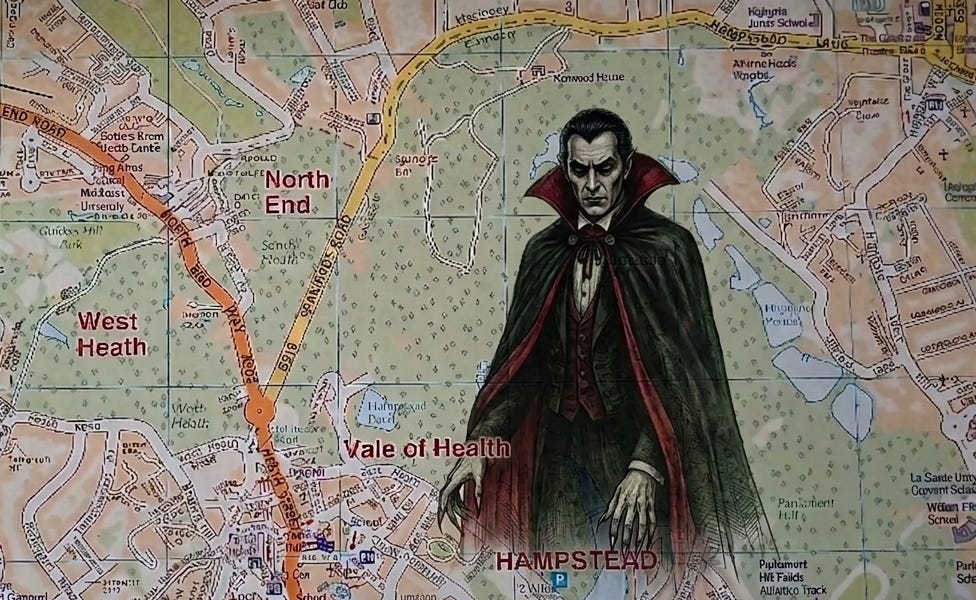
The character Lucy Westenra’s family home, Hillingham, is located near Hampstead Heath. She becomes Dracula’s first victim, and when she is finally transformed into a vampire herself, she haunts the Heath, preying on children, who refer to her as the ‘bloofer’ lady. Her burial place is the fictional Kingstead Churchyard, a combination of Highgate Cemetery and St John at Hampstead. Two local Hampstead Heath pubs appear in the novel. Jack Straw’s Castle ended its 300-year run as a pub in 2002, but the Spaniards Inn where Van Helsing and the other vampire hunters hail a cab after visiting Lucy’s tomb is still open and operating as a pub today. today.
My own horror novel The Hurdy Gurdy Man is set in a big, crumbling house on the edge of Hampstead Heath.
London Zoo
London Zoo in Regent’s Park also plays a part in Lucy’s story. It is here that Dracula releases the wolf ‘Berseker’ which later attacks the Westenra home on Hampstead Heath. You can read my substack on the connections between fantastical literature and Regent’s Park and Primrose Hill here.
Regent's Park and Primrose Hill
Victorian Vampires
My recent London History podcast discussing London’s Victorian Vampires for World Dracula Day can be found here.
Haunted Theatre Guided Walk
If you want to find out more about the Lyceum’s Dracula connections and creepy stories of the ghosts who haunt London’s Theatreland I am collaborating with Spooky Isles on a Haunted Theatre Guided Walk on Saturday June 13th.
You can book a spot here.
If you are ever visiting London you can book me for a private horror literature and and film tour here.