
Killers On The Streets
Tales of the London Fog

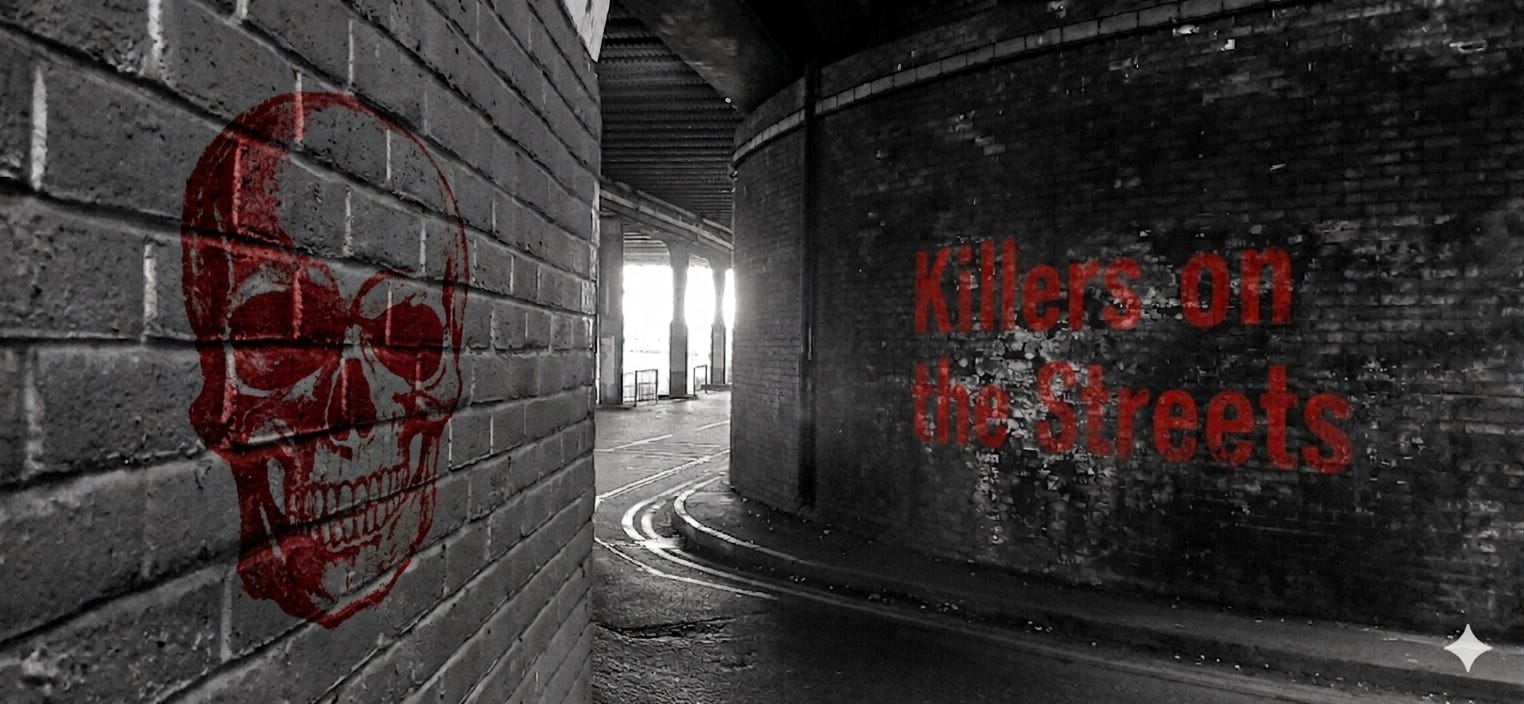
The Streets of London have seen their fair share of serial killers. Between 1888 and 1891 Jack the Ripper prowled the streets of Whitechapel. Not long after the Ripper’s last murder the Lambeth Poisoner, Doctor Neil Cream, almost matched the Ripper’s tally of five victims by poisoning four women in Waterloo and attempting to poison a fifth. A century later Dennis Nilsen terrorised the Muswell Hill area, murdering between twelve and fifteen victims.
In fiction, Sweeney Todd, the demon barber of Fleet Street first appeared in a Penny Dreadful in 1846, dispatching his victims with an open razor and transporting their corpses via the catacombs beneath St Dunstan’s Church to Mrs Lovett’s bakery, where their flesh was used as filling for her pies.
Todd’s character was the first serial killer to be depicted on the big screen in a British film during the birth of the silent era, not once, but twice.
Sweeney Todd – 1926 & 1928
The 1926 version was produced by British Masters of Photo Architecture, directed by George Dewhurst and with GA Baughan as Sweeney Todd. It was a fifteen-minute, one reel film, of which no copies have survived. There is no record of the other cast members. It is thought to have been filmed at the Poole Street studios in Islington North London.
The 1928 version, on the other hand, is a full-length seventy-minute feature, copies of which still exist today. Also filmed in Islington and produced by QTS Productions, it was directed by Walter West, who in the same year directed another silent classic murder movie, ‘Maria Martin, or the Murder in the Red Barn’.
Moore Marriot, who’d previously appeared in a 1923 adaptation of WW Jacob’s horror story, ‘The Monkey’s Paw’, and would later become better known for comedy roles during the talkie era, played the demon barber. Mrs Lovett was played by Iris Darbyshire, who also went on to play comedy roles in the 1930s.
Islington’s glasshouse studio was used to build a set which recreated Fleet Street in the 1840s. It also introduced the mechanical trapdoor beneath the barber’s chair which Sweeny Todd uses to dump the bodies into the tunnels beneath his shop.
The Lodger (A Tale of the London Fog)
In 1927, between these two versions of Sweeney Todd, came ‘The Lodger (A Tale of the London Fog)’ also filmed in Islington for Gainsborough Pictures. It was directed by 26-year-old Alfred Hitchcock, entering for the first time the serial killer genre that would later bring him fame and notoriety.
The script was based on the 1913 novel by Marie Belloc Lownes, inspired by the Jack the Ripper case, and a huge best seller at the time. Adapted for the screen by Eliot Stannard and Hitchcock’s wife, Alma Reville, the plot concerns a serial killer, known as the Avenger, whose victims, all blonde women, are killed on Tuesday evenings. The murders coincide with the arrival of a mysterious lodger at a home owned by the Bunting family.
Unlike the two Sweeney Todd films The Lodger was not entirely studio bound, with Hitchcock filming at various locations throughout central London, including Piccadilly, Westminster Embankment, and Fleet Street. A smoke machine was used to create the atmosphere of a fogbound London. Hitchcock makes the first of his trademark cameo roles in the film. He is seated at a desk in a newspaper office when the news of the Avenger’s first victim breaks.
Ivor Novello, a hugely popular actor and singer-songwriter of the era, was cast as the lodger. In the novel and the original rushes of the movie he turns out to be the murderer and is set upon by a vengeful mob. The studio balked at the idea of Novello being depicted in this manner and the ending was changed to show a case of mistaken identity with Novello being saved from the mob at the last minute by a newspaper headline announcing the arrest of the real suspect.
June Tripp, who played the daughter of the Bunting family, had previously appeared in ‘The Yellow Claw’, based on the Sax Rohmer story that was the forerunner of his Fu Manchu novels, frequently themselves made into movies.
Sweeney Todd Talkie (1936)
By the time the appropriately named Tod Slaughter took on the role of Sweeney Todd in the 1936 George King Productions’ talkie version he’d played the character over 2000 times, particularly at the Elephant & Castle Theatre in South London where he was actor / manager from 1923 to 1927.
The Cinematograph Films Act of 1927 introduced a system whereby, to compete with Hollywood, British cinemas had to show a statutory percentage of British made films. George King became the master of the type of low budget / quick turnaround often used to fill the quota.
With Sweeney Todd King and Slaughter proved a ‘quota quickie’ could also be a box office success if it combined horror and melodrama with a story familiar to audiences. Mrs Lovett was played by Stella Rho, granddaughter of Lady Lamington and daughter of Italian aristocrat Marchese Vitellische.
Like the 1920’s versions the 1936 Sweeney Todd was filmed entirely on studio sets depicting Fleet Street in the 1840s. On this occasion filming took place at the Shepperton Studios in Surrey.
East of Piccadilly (AKA The Stangler) – (1941)
By the time East of Piccadilly was filmed in 1941 a new act of Parliament had laid down a minimum spend requirement for British made movies, effectively ending the era of the ultra-cheap quota quickie. Consequently, the film has many scenes filmed at locations around the Piccadilly area - Piccadilly Circus, Wardour Street, Old Compton Street, Gerrard Street. Studio filming took place at the Welwyn Studios.
It was produced by Walter C Mycroft for the Associated British Picture Corporation and directed by Harold Huth, whose own acting credits included playing alongside Boris Karloff in The Ghoul (1933).
Scripted by J Lee Thompson and Lesley Storm and based on a story by Gordon Beccles, which was in turn based the true story of the Soho Strangler and four unsolved murders of local prostitutes strangled with silk stockings or other clothing items.
The film’s plot centres on Tamsie Drake (Judie Cambell), a crime reporter, who joins forces with writer Trelawny Hope, nicknamed ‘Penny’ because his Penny Dreadful style of writing, to investigate a series of murders. Their investigation takes them into the backstreets and nightclubs of Soho’s underworld. It a twist of misdirection it turns out that the strangler is least suspected character, the unassuming Jones, played by George Hayes.
Jack the Ripper (1959)
Mid-Century Film Production’s foray into the Jack the Ripper legend came in 1959. Directed by Monty Berman and Robert S Barker, the script was written by Hammer Productions stalwart, Jimmy Sangster. With an eye on the American market Hammer brought in Canadian born Lee Patterson to play Sam Lowry a detective from New York who comes to London to assist police with the Ripper murder investigation. (It was in fact a New York detective who helped solve the Lambeth Poisoner case in the 1890s)
Like Sweeney Todd before it Jack the Ripper was filmed at Shepperton Studios. However, filming also took place at locations out on London’s streets, particularly around Isleworth’s Swan Street and Lower Square.
Shot in black and white the screen turns to colour for the climatic scene where prime ripper suspect, played by Ewen Solon, is trapped and crushed to death in an elevator shaft, with the screen turning to colour to show his red blood seeping up through the floorboards. John Le Mesurier, future star of sitcom, Dad’s Army, and Pat Pheonix, future star of soap opera, Coronation Street, both have roles in the film.
The Cover Girl Killer (1959)
Six months later, in September 1959, a more contemporary serial killer was featured in ‘The Cover Girl Killer’, directed by Terry Bishop for Parroch Films (now part of Renown Pictures who also own the Talking Pictures TV television channel).
It stars Harry H Corbett in an early role before he became more famous for his role as Harold Steptoe in the iconic 60’s sitcom ‘Steptoe and Son’. He’s a serial killer who disguises himself in thick glasses and a wig to conceal his identity as the moralistically deluded murderer of cover girls who appear on the front page of the fictional glamour magazine ‘Wow’.
The Serpentine in Hyde Park and St. Anne’s Court in Soho provided key filming locations. The Walton studios in Walton on Thames became ‘The Kasbah Theatre’, based on notorious Soho strip clubs of the era such as The Windmill and The Nell Gwynn. Another set was The Mirror Photographic studio where a glamour photographer played by Victor Spinnetti tries to help police track down the killer and where the film’s climax plays out.
Peeping Tom (1960)
Photography is at the heart of ‘Peeping Tom’ directed by Michael Powell and made for his own independent film company Michael Powell (Theatre) Ltd. Up until then Powell had enjoyed a successful film career with his partner Emeric Pressburger, producing and directing highly acclaimed films such as ‘The Red Shoes’ and ‘The Black Narcissus’. While ‘Peeping Tom’ is considered a cinema milestone today, it was so harshly received and caused such an outrage it virtually destroyed Powell’s career, taking him years to regain his reputation.
The script was written by Leo Marks who had been a code breaker during the Second World War for the Special Operations Executive and whose father owned the bookshop in Charing Cross Road on which the 1987 film ‘84 Charing Cross Road’ is based. Mark’s himself based ‘Peeping Tom’s’ first victim on Dora, a local prostitute who used frequent the book shop when he was growing up.
The plot of the film centres on Mark Lewis (Karlheinz Bohm) a film technician who’d had a disturbed and abusive childhood. Using the sharpened leg of a tripod he forces his female victims to witness their own horrific murder through a mirror attached to the camera on which he is filming them. In the film’s climax he rigs up a similar set up to film his own suicide.
The film was made at Pinewood Studios in Buckinghamshire with location shots in Rathbone Place and Newman passage in London’s Fitzrovia area. Melbury Road in Holland Park where Michael Powell lived was used to depict the street where Mark Lewis lives and where the climactic scene takes place.
Frenzy (1972)
‘Frenzy’ marked Afred Hitchcock’s return to the UK after his time in Hollywood. ‘Psycho’, released in the same year as ‘Peeping Tom’ had received a more favourable critical reception than Michael Powell’s film. ‘Frenzy’ saw Hitchcock put a London slant on the serial killer genre he had made his own.
The original novel ‘Goodbye Piccadilly, Farewell Leicester Square, by Arthur Le Bern is set, as the title suggests around the Piccadilly and Leicester Square area, as well as slightly further west in Shepherd’s Market. For the film Hitchcock relocated the action to Covent Garden. His father had been a Covent Garden market trader. When the film was being made the famous fruit, veg, and flower market was about to relocate to Nine Elms in South London and as well as making a thriller Hitchcock wanted to document the area on film before it disappeared forever.
The plot concerns a misogynistic necktie strangler played by Barry Foster who is attempting to frame his friend Richard Blaney (Jon Finch) for the murders he’s committing. It’s said that Michael Caine was at one point considered for the necktie killer role.
Like ‘Peeping Tom’ ‘Frenzy’ was filmed at Pinewood studios. As well as the Covent Garden area locations also included the Old Bailey and Wormwood Scrubs prison. Hitchcock’s trademark cameo comes at the start of the film where a political speech at County Hall on the Southbank is interrupted by the sight of the naked body of one of the necktie killer’s victims floating down the Thames from the direction of Westminster Bridge. Hitchcock can be seen in the crowd that gathers to witness the event.
Straight on Until Morning (1972)
Released in the same year as ‘Frenzy’ ‘Straight on Until Morning’ was Hammer Productions’ interpretation of the modern London serial killer. Directed by Peter Collinson, who also directed ‘The Italian Job’, the script was written by John Peakcock who would go on the script Hammer’s big screen adaptation of Dennis Wheatley’s “To the Devil a Daughter” in 1976.
The film blends the kitchen sink gritty reality style of the late 60s with the story of a serial killer on the streets of trendy early 70’s London. Rita Tushingham plays Brenda, a working-class girl from Liverpool, who comes to London and falls for handsome and wealthy, Peter (Shane Bryant), secretly a ruthless killer who murders people he considers beautiful because be believes they have a hidden ugliness inside them. The title of the film comes from JM Barrie’s Peter Pan and in the film Peter’s character nicknames Brenda, Wendy. In nod to ‘Peeping Tom’ Peter collects the voices of his victims on audio tape.
Unusually for Hammer ‘Straight On Till Morning’ was filmed at EMI’s Elstree Studio’s in Boreham Wood rather than their own Bray Studios in Berkshire. Locations included Earl’s Court, Bayswater, and the Southbank centre in Waterloo. The early scenes depicting the area of Liverpool where Brenda comes from were filmed in Battersea and Lambeth in South London.
The film ends with Rita Tushingham’s voice playing back on Peter’s tape recorder as he prepares to murder her.
Last Night in Soho (2021)
Five decades after ‘Straight On Until Morning’ Rita Tushingham, along with fellow 60s and 70s screen icons, Diana Rigg and Terence Stamp, would turn up in ‘Last Night in Soho’, Edgar Wright’s tribute to the London serial killer films of that era. The script was a collaboration between Wright and Krysty Wilson-Cairns who also scripted the ‘Penny Dreadful’ TV series. Wright and Wilson-Cairns toured the backstreets and pubs of Soho to get a feel for the area they wanted to set the film in.
The plot centres of Eloise (Thomasin McKenzie) who, like Tushingham’s character in ‘Straight on Till Morning” moves to London seeking a brighter future. This time in the fashion industry. Through a form of surreal time travelling dreams she vicariously sees the world through the eyes and experiences of ambitious singer Sandie (Anya Taylor-Joy) who is being groomed and dragged down into the seedier side of Soho’s night clubs and sex industry by Jack, a pimp and sex trafficker played by former Doctor Who, Matt Smith.
The film uses a number of locations around Soho and Goodge Street as well as the Toucan pub on Carlisle Street where Eloise works as a part time barmaid, and London College of Fashion.
The Café de Paris (now closed) in Piccadilly forms a centre piece for the film’s pivotal dream sequence when Eliose first encounters Sandie in 1966. When Wright visited the Café de Paris to check it out as a potential filming location, he was disappointed with the size of its interior, which was much smaller than he imagined. So, he created an upsized film set version at Warner Brother’s Studio in Leavesden and used the exterior of the former Empire Cinema in Piccadilly’s Haymarket to stand in for the Café de Paris entrance.
The film’s 60’s feel was enhanced by a soundtrack which included Petula Clarke’s ‘Downtown’ and Cilla Black’s ‘You’re My World’. A ghost story and horror tropes are woven into the narrative and there are several instances of misdirection in terms of both the identity and the serial killer and that of the victims.
The film received several BAFTA nominations for its sound and production design and was voted best Horror Film by the Hollywood Critics Association, the Saturn Awards, and The Critics Choice Super Awards.
#
The former Cafe de Paris is one of the locations for my History of Horror Guided Walk for London Guided Walks, which also references some of the other films mentioned here. The next public walk will be on Saturday 23rd May. This walk is also available as a private tour.
Details here…
My horror novel ‘The Hurdy Gurdy Man’ published by Nightmare Press feature a 1960’s serial killer who is also part of an establishment cannibalistic cabal. Piccadilly Circus and Hampstead Heath are key locations.
Details here…